We had a ton to be excited about. We had survived the tornado. Our square footage was twice what it had been before the destruction. And in spite of what the “experts” had told us, we were debt free. Plus we had grown from a church of about 450-500 to more than 800 and were still growing. It was heady stuff.
People would ask us, “What is the secret to your success?”
All we could say was, “Okay, you start with a tornado…”
We didn’t have a clue.
Most of you probably don’t know this, but when “preachers” get together—and when they don’t—they talk to and about each other. Sometimes they like to act like they’re happy for your success. (They may be.) But they also ask goofy questions like, “How many you runnin’, Doc?” It’s a question about church attendance, which translated means: “Tell me you’re not doing better than I am!” Followed by the moniker “Doc” which translated means, “You and I both know you don’t have a real doctorate, but in case you earned one when I wasn’t looking I’m sure it’s not the kind that helps people.”
Anyway, when you’ve had explosive growth, humility is important. Especially when you don’t have a clue what caused it. The news of our success was about as welcome to the preacher party as a hooker.
But success is a blessing and a curse. Here’s what we found out. It takes a bunch of effort to meet the expectations of 800 people. And it takes a lot of staff. And it takes a bundle of “ministries” and programs. And, it doesn’t take long to become totally exhausted.
Here’s a little something I’ve discovered. I’ve discovered that when I’m exhausted, I have a tendency to begin to contemplate the cause of my exhaustion. Something like this:
“What in the world am I doing?”
What I was doing was what was expected of me, or so I thought. Was I trying to compete with other churches our size? Was I trying to grow the church through my own effort? Nobody had asked me to do it. I just didn’t know any other way. It seemed it was just “business as usual” in the modern church.
But it wasn’t long before I began to question “business as usual.”
All of the church growth materials we had read instructed us to create vision and mission statements, something we had never done. Now I understand why that is necessary. When you hit the wall, it really helps to know why you’re killing yourself. In other words, when you know your purpose, it puts everything into perspective. I can survive almost anything if my purpose is important enough.
It was not.
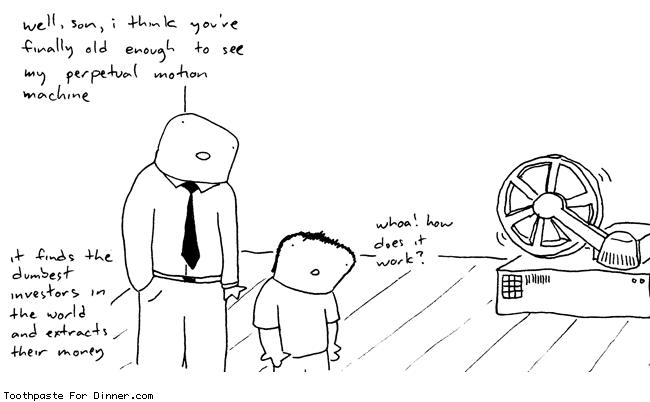
In fact, I don’t think I knew what my purpose was. We never got around to writing down, let alone publishing our vision. So, whatever mission I had made up in my own head was not worth this. This wasn’t “mission impossible.” It was mission imperceptible. The best I could figure, our reason for being, my reason for working 6 and 7 days a week was to perpetuate the machine.
That was not enough.
People would ask us, “What is the secret to your success?”
All we could say was, “Okay, you start with a tornado…”
We didn’t have a clue.
Most of you probably don’t know this, but when “preachers” get together—and when they don’t—they talk to and about each other. Sometimes they like to act like they’re happy for your success. (They may be.) But they also ask goofy questions like, “How many you runnin’, Doc?” It’s a question about church attendance, which translated means: “Tell me you’re not doing better than I am!” Followed by the moniker “Doc” which translated means, “You and I both know you don’t have a real doctorate, but in case you earned one when I wasn’t looking I’m sure it’s not the kind that helps people.”
Anyway, when you’ve had explosive growth, humility is important. Especially when you don’t have a clue what caused it. The news of our success was about as welcome to the preacher party as a hooker.
But success is a blessing and a curse. Here’s what we found out. It takes a bunch of effort to meet the expectations of 800 people. And it takes a lot of staff. And it takes a bundle of “ministries” and programs. And, it doesn’t take long to become totally exhausted.
Here’s a little something I’ve discovered. I’ve discovered that when I’m exhausted, I have a tendency to begin to contemplate the cause of my exhaustion. Something like this:
“What in the world am I doing?”
What I was doing was what was expected of me, or so I thought. Was I trying to compete with other churches our size? Was I trying to grow the church through my own effort? Nobody had asked me to do it. I just didn’t know any other way. It seemed it was just “business as usual” in the modern church.
But it wasn’t long before I began to question “business as usual.”
All of the church growth materials we had read instructed us to create vision and mission statements, something we had never done. Now I understand why that is necessary. When you hit the wall, it really helps to know why you’re killing yourself. In other words, when you know your purpose, it puts everything into perspective. I can survive almost anything if my purpose is important enough.
It was not.
In fact, I don’t think I knew what my purpose was. We never got around to writing down, let alone publishing our vision. So, whatever mission I had made up in my own head was not worth this. This wasn’t “mission impossible.” It was mission imperceptible. The best I could figure, our reason for being, my reason for working 6 and 7 days a week was to perpetuate the machine.
That was not enough.