Showing posts with label questions. Show all posts

Tuesday, September 20, 2011

What is a “Funk and Wagnall’s”?


A couple of my friends (family) have brought up the Orthodox and Roman traditions of following the “church calendar.” This something I truly admire. Unlike many Protestants, it is something of which I am starkly aware. If you have no idea what I am talking about you can research it here. Not just everyone in a local congregation follows it. The whole church, all over the world, follows it. It’s brilliant, really.

However, as much as I like this part, it is a practice that doesn’t go far enough for me and for two reasons. From what I have learned, this is a new generation that is unlike any before it. And they are filled with contradictions. First, they are a fatherless generation, so they are very leery of patriarchal systems. But secondly, in what seems to be a contradiction, they so badly need to be heard. Perhaps it is a direct consequence of such a paternal deficiency that they need to be heard.

Let’s unpack this seeming contradiction. First of all, they are known as a “fatherless” generation. This is arguably the distinguishing characteristic of the kids who are growing up in today’s world. Now stack that on top of the fact that they have more information and input at their fingertips than any previous peoples. Social networks, search engines, and even their favorite bloggers have more impact on their lives and their beliefs than strangers who claim to be “experts” ever will.

They display their lives online—at least the part they want you to see. They count on Wikipedia but have no idea what a Funk & Wagnall’s is, or was. The vast majority of them (90%+) have uploaded data, videos, and/or photos onto the internet. This generation was “born” online. That is why those born since 1990 are referred to as the iY Generation.

Dr. Tim Elmore wrote the book Generation iY: Our Last Chance to Save Their Future. In his promotional video for the book he says, “When I look at students today and schools (read churches) today, I see a gap. Students today are primarily right brain thinkers; schools (churches) are primarily left brain delivery. Students want to upload their own thoughts; schools (churches) insist on downloading information. And this chasm has led to a disconnect between adults and this emerging generation of kids.”

With so much peer influence, available data, plus paternal rejection, why would they seek out a pastor, a priest, or even a heavenly Father for exclusive input on matters of faith?

If you really want to do some research on this you could read this or this. If you don’t want to understand Generation iY, then you have the answer as to why we are having problems reaching them—indifference and a lack of understanding by the older generations. If you want to go even deeper you should read Elmore’s book.

But secondly, besides being dubious of single source authority, this generation, like no other before it, needs to be heard. Elsewhere on this blog, I have quoted author and former director of Alpha USA Todd Hunter. He says, “It used to be that people primarily listened their way into Christian faith. That made the Christian role talking: defending the faith, explaining the faith, doing apologetics, preaching, writing tracts, etc. While that reality is not entirely gone, these days outsiders are increasingly talking and observing their way into faith. They need to tell their story and see if Christianity is real. This major shift is difficult, because right when seekers are looking instead of listening, the church is at a high mark of un-Christian living. Transformation into Christlikeness has always been the goal of Christianity. Now it is utterly strategic—the future of the faith in the USA, humanly speaking, depends upon it.”

This makes our job listening and living it—two things we don’t do very well. What can the church do? Well, can we rethink our delivery? If not, we may need to prepare ourselves to lose an entire generation. How about simply changing our approach from, “Here’s the truth and you had better believe it and act this way!” to, “Here’s what Jesus said! Here’s my experience. Now, how do you think we’re supposed to live that out?” And then we shut up and listen to them. Not just one Sunday or one Wednesday, but every time we come together. Then that “format” becomes our liturgy.

That’s what happens every time we meet at Agora. Maybe you have a better suggestion. I’m wide open. Our community has evolved and hopefully is still evolving. I say all the time that we don’t think we have it nailed. In fact, I think the idea that we think we need to have “it” nailed is a major deficiency in the universal church today. (“It” meaning message and method.)

Here’s the thing. Could we possibly have enough trust in God and faith in our kids that they could hear from the Holy Spirit for themselves, beginning at a fairly young age? And that between them and us, we could work things out? That sounds like community to me. In our experience, it feels like a community too—wrestling with the questions, the words, the works, the faith, the doubts, the struggles, and the successes.

Finally, we must find a way to allow the kids to play a major role in the conversation. Not just around the Sunday lunch table, but where it matters most—around the Lord’s Table.

Wednesday, August 24, 2011

Child Ownership Fail (Nice Car!)


Once upon a time, a father bought his one and only newborn daughter a shiny new car. Cars were his passion. And since she was his only child, he wanted her to share his zeal for automobiles. He knew that she wouldn’t be driving it for some time, but he wanted her to be exposed to it from the very first week of her life. He was determined to have her to take ownership and drive it when the time came, but in the meantime he would keep it clean and ready for the day she would take it over.

From the time she was able to read, she didn’t go to regular schools; he took her to schools where they taught her all about cars. She took classes on driving, traffic laws, safety, and car maintenance. By the time she was twelve years old, she had memorized the interstate system, nationwide. She could take apart a transmission, replace the worn parts, and put it all back together again. And she could tell you everything there was to know about Henry Ford and the history of auto manufacturing in the United States.

When she turned 16, her school sponsors took her to Japan and South Korea to help her understand the durability and reliability of the well-made cars there. The next year they took her to Germany and all over Europe to meet the engineers and to see the great automobile plants of such legendary cars as Mercedes, BMW, Rolls Royce, Ferrari, Lamborghini, Bugatti, and several others you have never heard of.

In all this time, Dad kept the car clean and ready, but she had never driven it once.

On the morning of her eighteenth birthday, the day finally arrived. She had spent her whole life preparing for this day. She knew everything there was to know about cars. Today, she would get to drive one for the first time. After breakfast, her dad handed her the keys and said, “Now you are ready.”

Perhaps you can anticipate what is about to happen. Before she got out of town, she was killed in a tragic auto accident. She had studied her whole life, but she had never once been given the opportunity to drive. She knew everything about cars, but she had never been behind the wheel.

This is the story of the American church and its children. We have given them knowledge, instruction, and pizza by the ton, but we have not let them get behind the wheel. We have failed our kids by withholding ownership of the gospel. Instead we have kept it clean and shiny for them and just out of reach. Instead of handing them the keys as early as possible and sitting next to them for the wild ride, we have kept the keys in our pocket.

We have tried so hard to keep them in the insulated church bubble and isolated from the real world, because we feared they might fail. We just couldn’t let them doubt or question or find their own answers. That was too dangerous. We can’t bring ourselves to let them go there; not on our watch. And by refusing to let them fail, we have also kept them from taking faith deep into their souls.

And here’s some real irony. If they did fail in spite of our efforts, we did not know what to do with them. We did not know how to show them love, forgiveness, and compassion without making it appear that we condone their actions. God will gladly take them back, but we won’t. Our church culture doesn’t allow it.

So instead of admitting that the failure of the best people in the scriptures as well as in real life is as common as rain, we have to pretend to be appalled and disappointed. And if they are leaders in the group, instead of finding ways to restore them and make them examples of God’s forgiveness and love, we make them examples of shame and humility, and we set them aside to show the other kids where sin will get you.

Thirdly, we have failed our kids by withholding the keys to ownership of the faith entrusted to us. And in so doing we can predict the car wreck that inevitably comes when they finally come face-to-face with the real world.

Friday, August 19, 2011

Ask More Questions


So, while it is important to withhold our conclusions before we have enough information, there is something we can do. But it may be too simple to be significant.

When I was in school, I was famous for being the guy who was unafraid to ask questions—especially in math classes. If I didn’t understand something, I always wanted clarification. I don’t know this for sure, but I would have bet that if I had questions other kids in the class did too. So I always stuck my hand up before we moved on too quickly.

Sometimes the answer to that question made me ask even more questions. But once it sunk into my thick skull and I finally understood it, my wife of 35 years, who was in class with me from the eighth grade on through high school, use to tell me that I would always close my little inquiry by saying, “O, I see.” (I think the implication was—now that I have grown old and have had time to think about it—that this repeated phrase became rather obnoxious: “O, I see!”)

Consequently, I bring that part of my life to this problem—both the inquisitive part and the obnoxious part. I guess I always liked to understand, whatever it was. So, I’m no different today than I was then. When it comes to the church, if I see that something is not working, I still want to stick up my hand and say, “Excuse me; I have a question.”

Perhaps this is the beginning of acquiring the help we need. I know that there will be many steps in this journey that we are beginning together, so we need to have not only a starting place but also a place to which we can return in case we stray a little off the path. But not like the inference ladder feedback loop where we return only to our selected data that reinforces what we already think we know. Instead, I think we have to wipe the slate clean and start over in the seemingly bottomless pool of available data.

But how do we do that? We have already conceded that there is far too much information. We’re swimming in data. So, being the rather simple-minded man that I am, I have tried to boil it all down to something really easy that maybe we can apply to whatever situation in which we find ourselves. It is simple, and it’s not really that profound either. Sorry.

Here it is: Ask more questions. Good questions. Obvious, right?

Maybe not. What I think I have found is that, as the church, we are often too quick to draw conclusions and then make decisions about how to proceed without subjecting our conclusions to just a little bit more scrutiny. Even worse than that. We are not likely to question anything that has become an established practice over a period of decades. Why? (There I go again.) It seems to me that it would be beneficial if we would ask at least one more question. For example…

Wednesday, August 17, 2011

Whose Agenda?


In my studies, particularly my reading over the last decade, I have heard the voices from within and from without the church. Much of the study I did had to do specifically with the church, especially what might have gone wrong along the way. But some of it had to do with other things like creativity, education, worldviews, culture, art, beauty, and relationships. Missiology too. But no matter what I read, it was always with the church in mind and what we, as followers of Jesus, needed to rethink. Turns out, it might be just about everything regarding method if not dogma.

Unfortunately, even among some of the most fascinating of writers, I have run into a common thread. They all, apparently, have the answer(s). Especially with regard to this conundrum of church, their research led them in a certain direction and ultimately they had come to one conclusion or another about the answer as to how we ought to “do church.” Of course none of them agree.

In the beginning I would read along with great interest and hope. These are mostly people whose journeys have been similar to my own. I would relate to their frustrations and their questions. I would respond with thoughts like, “Yeah! Me too!” Or, “Wow, that is exactly what I have always thought!” However, sooner or later there would come a point at which I would end up saying, “What? No, really? That’s your result?” That’s because obviously each writer feels the need to provide his readers with the right solution to the mystery.

I think my college literature professor may have told us that. Something like, “Good writing presents us with a problem and then proceeds to solve it.” Or maybe it was, “Tell them what you are going to tell them; then tell them; then tell them what you told them.” Apparently publishers are also pretty picky about this sort of thing. Because, I have yet to read one that didn’t spell out some specific pattern or model to follow in order to solve the problem.

If God is speaking to each of them, he is saying something different about what the church ought to do in each of their circumstances. Which kind of makes my point. Their particular conclusions are presented as the answer—the one and only answer to every situation. Maybe that’s not the way they mean it, but that’s the way it sounds. I don’t think there is only one answer to the question of what the church should be doing in any given city or community. I think the questions and concerns are similar across the board, but I think the right conclusions and solutions for the church are as varied as her people.

My purpose here will be to try and ask the right questions, give you our attempts at solving them, and leaving the rest up to you.

Sunday, December 28, 2008

Don’t Try This at Home


To say that this was only the beginning is a huge understatement. I found that once you start to ask questions, it’s really hard to stop. There were so many moments after the rebuild when I just couldn’t understand the whys. Why do we do what we do? Why do churches and their people expect what they expect and therefore demand what they demand? Let me hasten to say, this wasn’t about scurrilous people or evil intentions. It was about the system that we all inherited.
I mean, where did we get the idea that we needed a professional to do our preaching, praying, teaching, singing, caring, giving, helping, hoping, connecting and communicating with God? The scripture says very distinctly that there is only one mediator between us and God (1Timothy 2:5). In fact, we believed and taught the concept of the priesthood of every believer (1 Peter 2:9, Revelation 5:10). But what we did spoke so loudly that no one could hear what we were saying.
Like bad parents, we said one thing and did another. We were like, “Look, it’s easier if I just do it myself. You just sit there and watch me.” Or like a television program full of life-threatening stunts, “Don’t try this at home. We’re trained professionals.” Why are we surprised when that’s exactly what happens?
For about four years the church hosted and I headed a ministerial training program required by our denomination for credentialing. It was quite extensive—four years of work, more than thirty different classes. And although I tried to secure enough teachers for each trimester, I often got the privilege of teaching one or more classes each time. One of my favorites, one that became a bit of a diversion, was the subject of church history. I was fascinated with it.
Here’s the kicker. Once I had been through the destruction of a tornado and the questions that went with it, my understanding of church history became skewed to the point of confusion. But I wasn’t confused about the history. I was confused about what we had chosen to do with the knowledge we had.
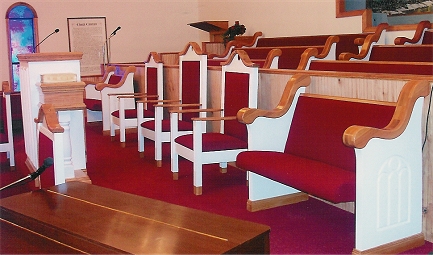
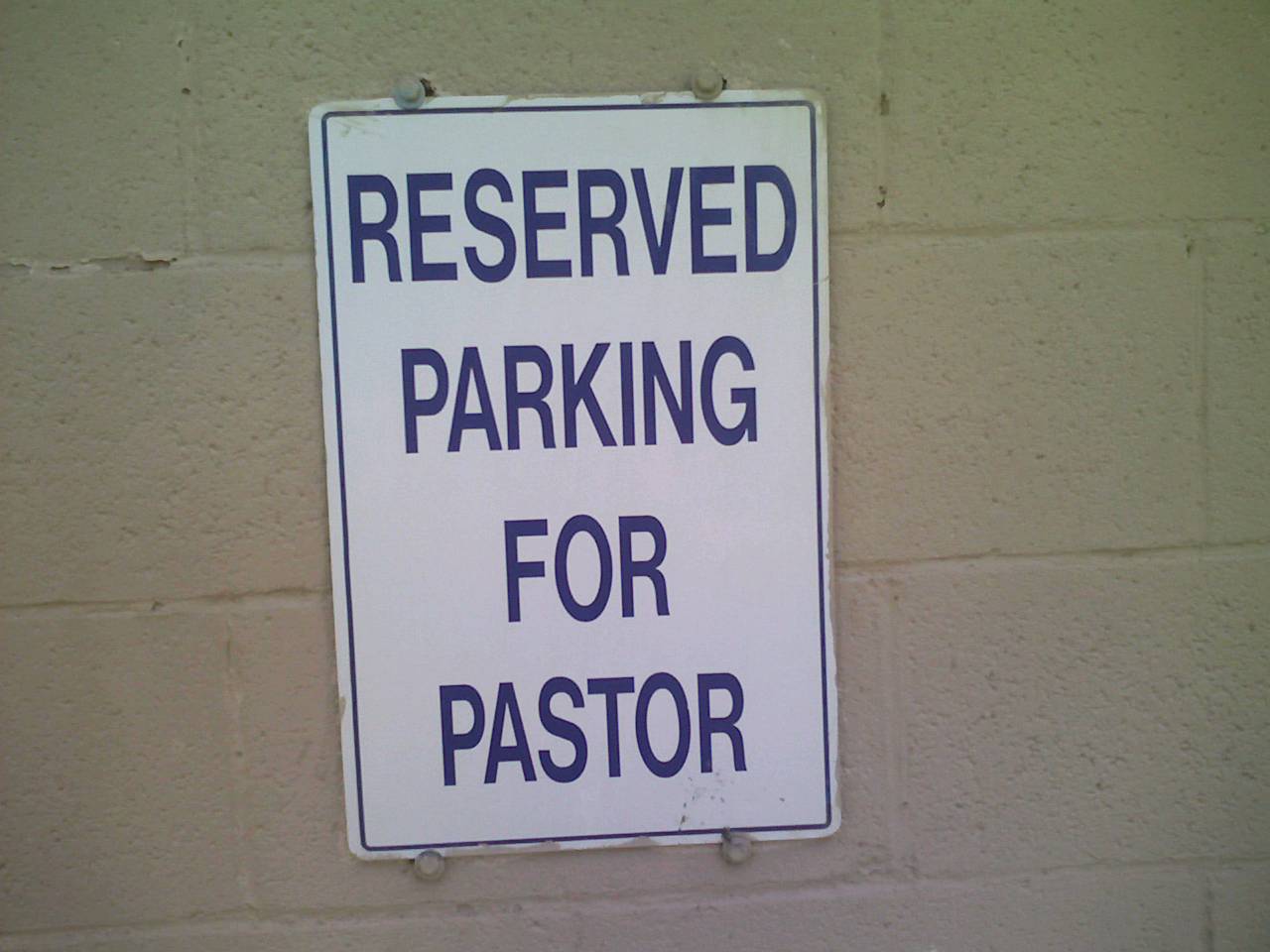
In my own tradition, I couldn’t see the New Testament pattern for pulpits, platforms, thrones, and reserved parking places which you can find in virtually every church. In other traditions, I couldn’t comprehend the spiritual significance of rituals, robes, confessionals, and funny hats. It seemed to me that Jesus had provided a replacement for all of that—himself.
Then one day, as if I needed “fuel on my fire,” I met up with a guy I had heard speak before. His name is Earl Creps. This man changed my life forever.

Sunday, December 21, 2008

Long Range Plans


Part of the process of deciding to rebuild and committing to stay on the same property was drawing up plans that would maximize the potential of those 10+ acres upon which Carbondale sits. Given the land we had, what is the largest size to which we could grow there? As the ideas were developed, our architect sketched out a three-phase plan.
The first phase was for the short term. This would answer the question: What will get us operating on that property again in the shortest amount of time? The second phase was a medium range plan that would get us up to the larger, more expanded size that we felt we needed as soon as we could afford it. And the third phase was the long range plan. It was the plan to construct as much building footprint, with the required adjoining parking, plus whatever infrastructure necessary in order to maximize the property.
The long range plan would include a new “sanctuary.” And that would determine just how big we could get without buying more property. Early on, it was discovered that we could likely build between a 1,200 and a 1,500 seat sanctuary and the accompanying meeting rooms, office space, and parking on that land.
Plus, we got the privilege of building a retention pond for about $85,000. This was made a requirement by the city and was officially called a “privately funded public improvement” or PFPI. In other words, we got to pay for fixing the city’s problem with drainage in our neighborhood. You can drive by and see that lovely monstrosity today. It was built before almost anything else.
This may be more than you need to know, unless you plan to build anything within the Tulsa city limits. Then it’s good stuff to hear. But here’s some more advice to go along with the above. We learned that you can fight City Hall. But you will lose.
Eventually we decided to opt for phases one and two, immediately. What’s an extra two million dollars among friends? But the third phase, the long range plan is still in the works even today.
Once the rebuild was finished and we had moved back onto the property, the details of the third phase started to take shape. We continued to meet with the architects, Paul Meyer and Gary Armbruster of Meyer Architects in Oklahoma City.
One night in the middle of all of this “long range” planning, I could not sleep. I tried everything. I tossed and turned—more like: flopped like a fish. I gave up, more than once, got up and read thinking that would make me sleepy. When that didn’t work, I tried reading the “begats” of the Old Testament. Even that didn’t work. I tried praying, begging God to kill me, tell me what he wanted, or let me sleep.
I finally decided that God was trying to get my attention.
“C’mon, God!” I pleaded. “All my friends get these elaborate dreams with deep meaning and obvious application to their current circumstances. Why can’t you do that for me? At least I would get to sleep!”
But no, not for me. Beside the fact that all my dreams are stupid, I finally surmised this was supposed to be some kind of direct encounter. I’m a little dense at times. At last, I gave in.
“Okay, God. What is it you want to tell me?”
Now, you would think that would be all the capitulation that God would need. And that he would just spit it out. I mean, believe me, I was all ears. But no. We were only half way through the night. And this was going to take all night.
I began my humble contrition by kneeling in the den by the couch upon which I had been sitting to read. No need to bother Vicki any more than I already had. She had mostly slept through my flopping anyway. I stopped begging and just shut up. Although, every now and then my brain would involuntarily scream, “What?!” In the deafening silence, I was trying to find a comfortable position from which I could hear the voice of God. In the process, I tried every position in the Yoga book and a few others I made up. Finally I ended up on my knees with my back arched over and the top of my head on the floor like a contortionist Muslim praying toward Mecca hell.
I wish I could tell you that I emerged from that horrible night with a lovely, illuminating, and Divine Word. I wish I could tell you that after that night everything changed. But none of that happened. However, while waiting to hear something really important, I couldn’t stop thinking about that stupid “long range plan.”
Specifically, the phrase that kept coming back to me was, “What will the church look like in 10 to 20 years?” So, I kept straining like a constipated man to come up with an answer to that question. And the only answer I could come up with was formulated out of the context in which we were already operating.
“Perhaps we ought to build something more like a theatre instead of a church sanctuary,” I thought. This was in keeping with our new emphasis on music and elaborate productions. So I envisioned a full production stage with fly-in scenery walls, multiple curtains, catwalks, and a sophisticated array of sound and lights. I even dreamed of an orchestra pit on hydraulics that would raise and lower into a basement rehearsal room. Some of those ideas actually got incorporated into the new sanctuary plans.
It never occurred to me back then that it was the question. The question was all I was supposed to take with me that night. I almost developed an aneurism trying to come up with an answer. But my answer was not the point. It would still be several more years before I would ask that question in a different context.
What will the church look like in 10 to 20 years?